Further Education vs Higher Education | Key Differences
On This Page

August 25, 20267 min read
Choosing the right path in education can be confusing, especially when terms like further and higher education are often used interchangeably. Whether you're returning to study, exploring career progression, or supporting someone else's learning journey, understanding the difference is essential. This quick guide breaks down what sets further education and higher education apart, from qualifications and course levels to career outcomes, so you can make an informed decision that suits your goals.
We'll clearly explain what each pathway involves, what qualifications you can earn,internships for high school students, and how they align with your personal or professional goals, helping you make the right decision with confidence.

Top NVQ Courses Offered by Hurak
Looking to boost your career with a nationally recognised qualification? Hurak provides a range of NVQ courses tailored to various industries. Here are some of their top offerings:
Level 2 NVQ in Plant Operations: Perfect for operatives aiming for the CPCS Blue Card.
Level 2 NVQ in Controlling Lifting Operations (Slinger Signaller): Ideal for those working in crane and lifting operations.
Level 3 NVQ Diploma in Adult Health and Social Care: Advance your role in care with this popular qualification.
Level 3 Award in Education and Training (AET): Start your journey to becoming a certified trainer or teacher.
What Is Further Education (FE)?
Further education (FE) refers to any type of learning that takes place after secondary school but isn't part of a university degree or higher education. It offers a diverse range of qualifications, from academic courses to practical and vocational training, providing individuals with the skills needed for the workforce or further studies.
FE is typically delivered in colleges, training centres, or adult education providers. Common qualifications include:
A-Levels
BTECs
NVQs (National Vocational Qualifications)
Apprenticeships
Functional Skills
The good thing about FE lies in its flexibility; courses are available part-time, in the evenings, or even online, making it an ideal option for those with work or family commitments. Whether you're looking to build practical skills, pursue a specific career path, or prepare for higher education, further education offers a variety of routes to meet your personal and professional goals.

What Is Higher Education (HE)?
Each year, thousands of UK adults enrol in higher education to gain specialist qualifications, switch careers, or advance in their current roles. Higher education refers to studies undertaken after completing further education, typically at university level. It includes qualifications such as:
Bachelor's Degrees
Foundation Degrees
Higher National Certificates (HNCs) and Diplomas (HNDs)
Master's Degrees
Doctorates (PhDs)
These programmes are more academically focused and often involve in-depth study, research, or theoretical learning.Most full-time HE courses take three to four years to complete, though part-time and distance learning options, such as online MBA, are available .
Unlike further education, HE often leads to advanced qualifications required for roles in law, engineering, teaching, or healthcare.

Key differences between further and higher education
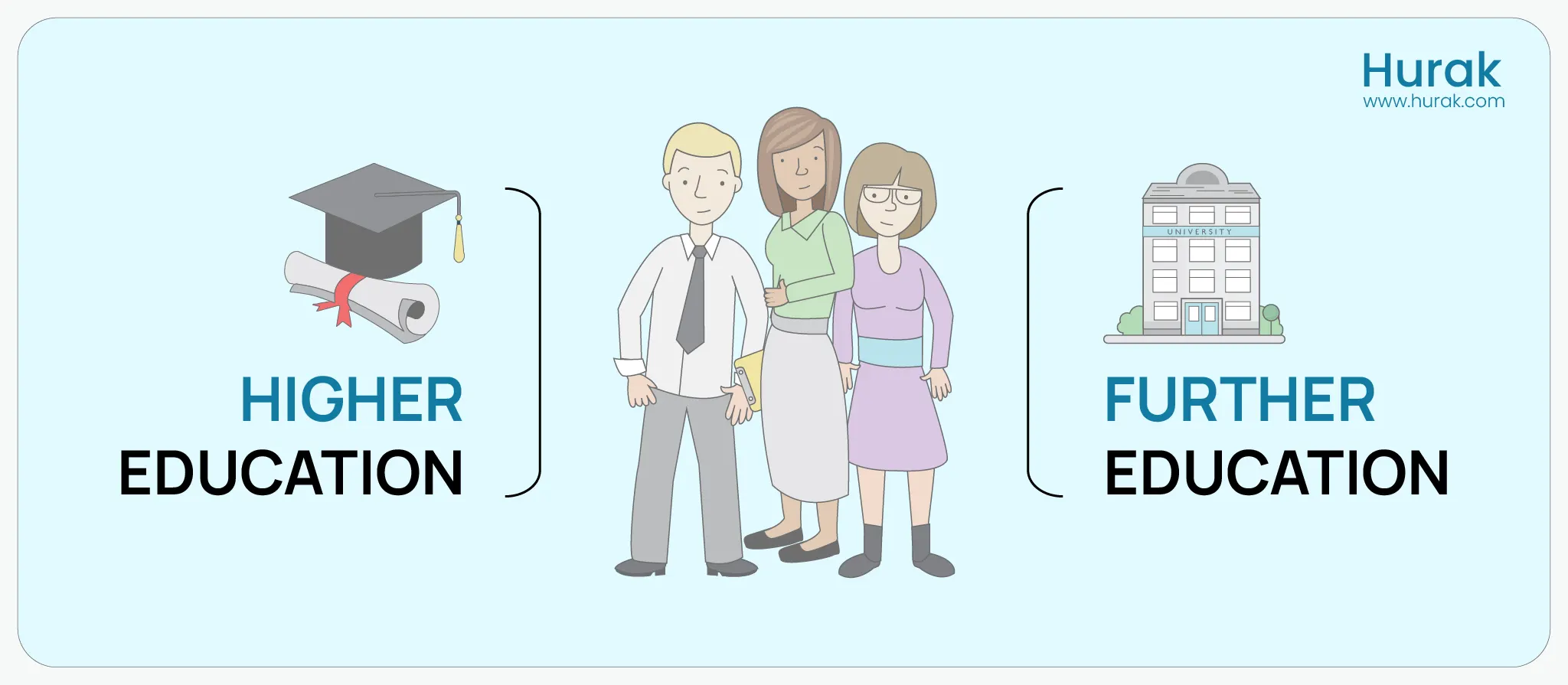
Further education (FE) and higher education (HE) serve as distinct milestones in your learning journey, each providing unique opportunities for career progression and academic development.
Level of Study
FE: Post-secondary study, often providing a foundation for future higher learning or specific job preparation.
HE: Advanced academic study, typically pursued after completing FE, offering qualifications like Bachelor's and Master's degrees.
Qualification Types
FE: Focuses on practical skills and vocational qualifications such as BTECs, NVQs, and apprenticeships.
HE: Offers academic qualifications like degrees, which delve deeper into specialised knowledge and research.
Duration & Flexibility
FE: Shorter, flexible study options, often one to two years, with part-time or online opportunities.
HE: Longer courses, generally lasting three to four years, are usually full-time with more structure.
Career Pathways
FE: Ideal for entry-level positions, apprenticeships, or preparation for higher study.
HE: Leads to professional and specialist careers requiring advanced qualifications, such as law, engineering, and medicine.
Below is a table for your quick reference of the key differences:
CATEGORY | FURTHER EDUCATION | HIGHER EDUCATION |
Qualification Levels | Level 1 to Level 3 | Level 4 and above |
Typical Providers | College, Training Centres | Universities, HE institutions |
Entry Requirements | Often minimal, depending on the course | Usually A-levels or equivalent |
Cost | Often free or low-cost | Tuition fees apply (loans available) |
Study Focus | Practical, job-ready skills | Academic, subject-specific knowledge |
Time Commitment | Varies, often short or part-time | 24+ years (mostly full-time) |
Which Path Is Right for You?
Deciding between further education (FE) and higher education (HE) comes down to your goals, qualifications, and learning preferences. Each route offers valuable opportunities; it's about finding what fits your current stage and career plan.
Choose Further Education if you:
Need to gain foundational or Level 3 qualifications.
Need to develop job-ready skills quickly.
Prefer practical, hands-on learning environments.
Explore career options or return to study with flexibility in mind.
Choose Higher Education if you:
Aim to earn a university-level qualification (Bachelor's, Master's, etc.).
Plan to enter a profession that requires a degree (e.g. law, teaching, healthcare, or specialised roles like earning a master's in speech pathology online).
Enjoy academic study and want to explore a subject in depth.
Prefer a longer-term learning commitment with research opportunities
Whichever route you choose, both FE and HE can lead to rewarding careers. It's about picking the one that aligns with your personal circumstances and long-term goals. For those who have already completed higher education and wish to take their expertise to the next level, postgraduate programs such as MBAs can be a powerful way to advance professionally. These programs, like the Evening MBA Degree, offer a flexible, innovation-driven curriculum designed for experienced professionals seeking leadership growth in dynamic industries.
Not Sure Which Path to Take?
Hurak offers courses to support both Further and Higher Education goals:
Choose Further Education if you want job-ready skills fast:
Choose Higher Education Prep if you're aiming for advanced roles:
Level 5 Diploma in Teaching (QTLS Route)
FAQs
What is the main difference between further education and higher education?
Further education (FE): Courses below degree level (e.g. A-levels, BTECs)
Higher education (HE): Degree-level and above (e.g. BA, BSc, Master's)
Do I need further education before I can do higher education?
Often yes, as most university courses require Level 3 qualifications
Alternative pathways, like Access to HE or relevant work experience, may apply
Can I go to university without A-levels?
Yes, through:
Access to HE Diploma
BTEC Level 3
NVQ Level 3
Foundation degrees
Work experience in some cases
Is further education free in the UK?
Yes, for most 16 to 19-year-olds
Adults may qualify for:
Free Level 3 courses
Advanced Learner Loans
Support based on income or employment status
How long does further education take?
Short courses: A few weeks or months
Full-time courses: 1 to 2 years
Part-time/evening options: Flexible duration
What support is available for adult learners?
Financial support (grants, bursaries, payday loans, or personal loans)
Flexible schedules (evenings, online, part-time)
Free advice via the National Careers Service or local colleges
Is higher education worth it?
Yes, for careers that require degrees (e.g., teacher, nurse, lawyer). Vocational jobs may offer strong earnings with FE alone.
Can I do both further and higher education?
Yes, many learners progress from FE to HE. Example: BTEC Level 3 ? University degree.
Final Thoughts
Both further education and higher education play important roles in helping you reach your personal and professional goals. Whether you're aiming to enter the workforce quickly, build practical skills, or pursue a degree for a specialised career, the right path depends on your current situation and long-term ambitions.
Understanding the difference between further and higher education helps you make informed decisions about your future. FE provides flexible, skills-based learning, while HE offers academic depth and professional qualifications. Consider your career goals, study preferences, and current qualifications before deciding.
You can also speak to an education provider or careers adviser to get tailored guidance and make the most confident choice for your future.
Explore Hurak's career guides to find the right path for your goals.
Hurak offers accredited courses that open doors in teaching, assessing, and supporting roles in education.
Start building your future today: Award in Education and Training (AET) | Teaching Assistant Courses
We also offer pathways into quality assurance and assessment: Assessment Training | IQA Training
Related articles



Explore more from Hurak
Courses
Upskill with job-ready training.
Mock Tests
Measure your learning progress.

Teach the World Online
Create an online video course, reach students across the globe and earn money