Minimum working temperature UK: A complete guide for workers, what the law says
On This Page

July 16, 20267 min read

Cold winter mornings, scorching heatwaves, and freezing warehouses are more than just a workplace inconvenience. Temperature is an important part of workplace health and safety. Working in cold or hot conditions can reduce concentration, increase illness, fatigue and injuries.
The minimum working temperature in the UK is a topic that causes confusion among employees because the UK law doesn't set a single number. Instead, employers are required to provide a reasonable working temperature and to take appropriate steps to control risks associated with cold or heat. We’ll look at what the law says, the guidance used by regulators, and how temperature rules apply differently to indoor and outdoor work. Whether you’re an employee or an employer, understanding these rules helps protect health, safety, and well-being at work.
Is There a Legal Minimum Working Temperature in the UK
What are the minimum and maximum legal working temperatures in the UK? But there is no legally defined minimum working temperature in the UK. The legal framework is the Workplace (Health, Safety and Welfare) Regulations, which require workplace temperatures to be reasonable. Rather than setting a specific number, the regulation primarily focuses on protecting workers from harm.
Understanding the differences between law, ACOP, and guidance is becoming increasingly important. The ACOPs explain the recognised way to comply; the law sets out employer duties; and guidance provides practical examples.
Employers have a clear duty of care to manage risks linked to cold conditions. This means assessing the environment, listening to employee concerns, and taking reasonable steps to protect health and safety, even without a fixed legal temperature limit.
HSE Guidance: What Is Considered a Reasonable Minimum Temperature?
While UK law does not set a fixed limit, the Health and Safety Executive (HSE) provides guidance to help employers meet workplace temperature requirements. For most indoor work, the HSE recommends a minimum temperature of 16°C. while 13°C is suggested as the minimum for workers involved in a physical environment. These temperatures are guidance only, not legal limits. They help to guide employers, not to act as a rule.
Comfort is affected by more than just the temperature reading. Workers who are active may feel warmer than those doing desk-based tasks. Air movement, drafts, and humidity can also change how cold a space feels.
Suitable clothing and PPE that can help keep workers warm. These factors help employers manage workplace temperature safely and fairly.
Indoor vs Outdoor Working Temperatures: What’s the Difference?
Indoor and outdoor workplace temperatures vary and are managed differently under workplace temperature guidance, given their different conditions.
Outdoor workplaces, including construction sites, agricultural roles, delivery routes, and utility work. They are directly affected by outside temperature and weather conditions. The external environment cannot be controlled as easily as an indoor environment. Instead, employers must focus on reducing the risks created by exposure to cold, heat, wind or rain.
In indoor workplaces such as offices, warehouses, shops, and other retail spaces, employers can control indoor temperatures. Heating systems, insulation, and building layout all contribute to maintaining a reasonable temperature. Employers are expected to monitor conditions and act if the temperature falls to uncomfortable levels.
Employers have a responsibility to help workers control their exposure to heat in the workplace by implementing safety measures such as suitable clothing, adequate break facilities, warm beverages, and the flexibility of hours or work location when necessary. Reducing the time workers spend on the same task, rotating tasks, and using other practical controls will also help lower their risk.
Conducting regular assessments of risks, particularly during periods of extreme weather, is essential in determining the risks associated with working outdoors, depending on the methods of control used rather than on temperature levels.
What Temperature Can You Refuse to Work in the UK?
There is no fixed right to refuse work on the basis of temperature in the UK; the law does not set a specific temperature. The question is: what temperature can you refuse to work at? The answer doesn't have a simple number; it depends on risk rather than number.
Employees may refuse to work when they believe that the work presents a serious and immediate threat to their health or safety. If extreme temperatures create an actual risk, such as hypothermia, heat stress, or impaired judgment leading to injuries, they would qualify.
Employees who express legitimate concerns about workplace hazards are protected by health and safety laws. Employees should not be discriminated against by their employer for taking action to protect themselves if that action is reasonable.
In many cases, simple adjustments can reduce risk. Open discussion helps avoid conflict and keeps safety at the centre of decision-making.
Employer Responsibilities: Managing Cold Working Conditions
Under UK health and safety law, employers have a legal duty to protect workers from risk linked to cold working conditions. Cold working conditions are not just uncomfortable, but they can affect workers' health, safety and performance.
Common control measures include a few factors:
Heating: Provide suitable heating where possible, particularly in indoor workplaces, to maintain a reasonable working temperature.
Warm PPE: Provide protective clothing that is suitable for the environment and task.
Job rotation: rotate tasks to reduce individual exposure to cold areas.
Insulation: Reduce heat loss by maintaining the thermal envelope of buildings and equipment.
Hot drinks: Make warm beverages available to help workers stay warm.
Rest breaks: Allow workers to warm up regularly, especially during prolonged exposure.
Employers must pay special attention to those workers who are considered to be more vulnerable, such as lone workers and those who work night shifts, because of increased risks associated with colder temperatures. Risk assessments are important aspects of identifying risk factors early and ensuring that appropriate controls are put into place to rectify any issues identified through the risk assessment process.
What About Hot Temperatures at Work?
Heat and humidity are two primary conditions of a physical work environment; however, acceptable environmental conditions of work do vary by person according to their level of activity, individual health conditions, and environment. An example of the difference in working conditions is a factory where employees perform manual handling of products and materials versus an office environment with good airflow, where employees typically sit in a chair and work on computers.
Although there are many other factors affecting the temperature at which it is safe for employees to work, studies indicate that temperatures that exceed 32 degrees Celsius create a risk of harm to workers, particularly those workers who are engaged in physically demanding tasks.
Exceedingly hot work settings pose a wide variety of health hazards to employees, including:
Dehydration from excessive fluid depletion. Symptoms of dehydration can include dry mouth, excessive thirst, and inability to urinate.
Heat cramps are characterised by painful muscle contractions occurring in workers as a result of high levels of physical exertion.
Heat rash, commonly called prickly heat, occurs when workers sweat profusely while performing strenuous activities. Heat rash is characterised by itchy, red, raised bumps on the skin.
Heat exhaustion often presents itself as excessive sweating, fatigue, dizziness, headache, nausea and fainting.
Hyperthermia or heat stroke can be fatal and is characterised by the failure of the body's natural physiological mechanisms for thermal regulation, leading to an increase in body temperature beyond acceptable safe limits.
The key is managing risk. Employers should assess conditions and adapt controls as temperatures rise to protect worker safety. There are some control measures, including:
Hydration: Ensure workers have easy access to drinking water to prevent dehydration.
Ventilation: Increase air movement to remove hot air and improve comfort.
Flexible hours: Adjust working times to avoid extreme heat.
Shade: Protect outdoor workers from direct sunlight.
Heat stress can affect physical health and mental alertness, increasing accident risk. By assessing risks and applying sensible controls, employers can maintain safe working conditions even during hot weather.
Common Myths About Workplace Temperature
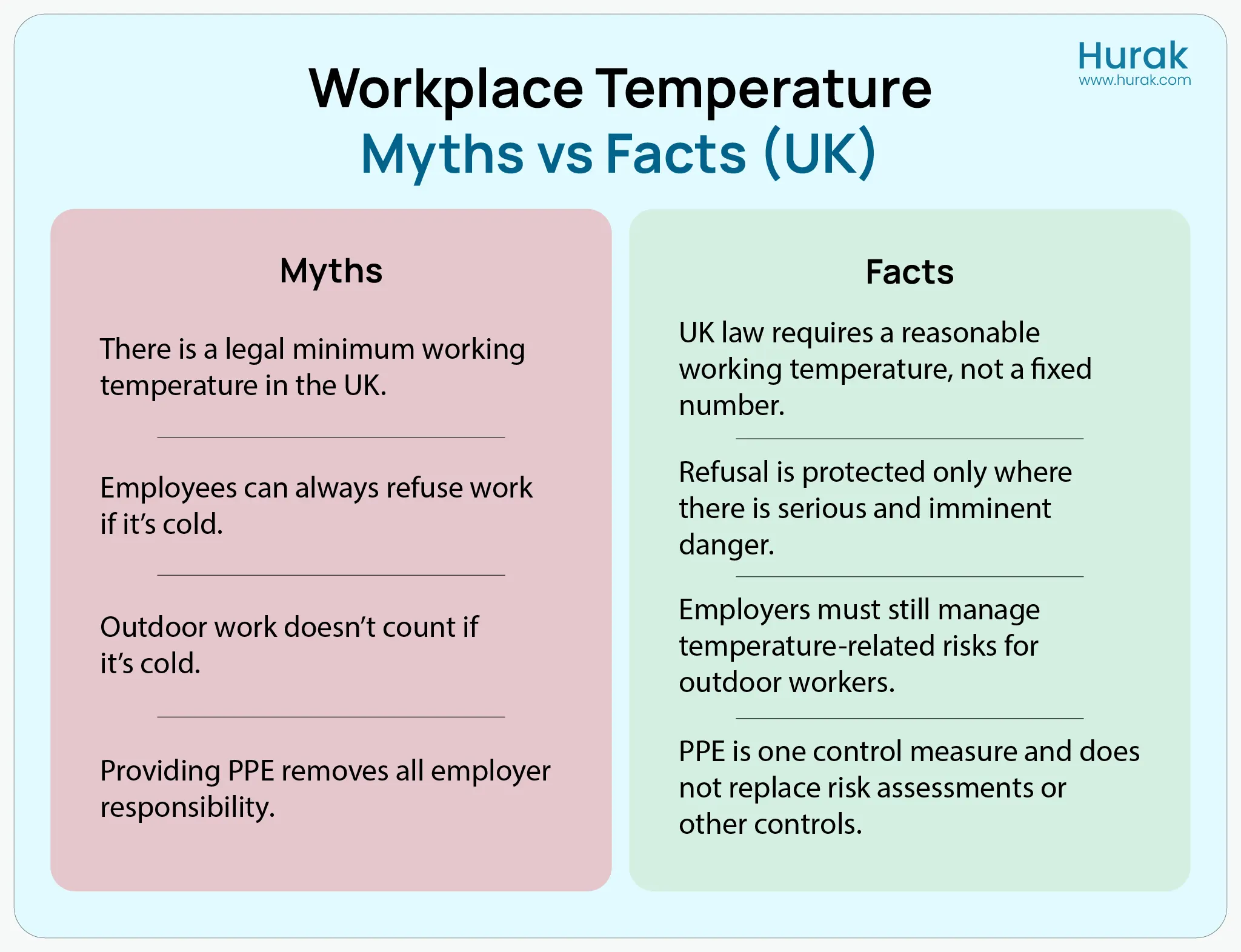
Workplace rules are often misunderstood. Several myths continue to circulate around workplace temperature, but there is no fixed legal minimum temperature. Employees cannot refuse to work because it is cold; they can refuse to work only when a serious risk exists.
Understanding these myths leads to better decisions and workplaces. Outdoor work still falls under health and safety law, and PPE does not fulfil the employer's responsibility; the employer must take a broader approach.
Practical Steps for UK Employers to Stay Compliant
Temperature compliance in the workplace doesn’t have to be complicated or require expensive, complicated equipment. By focusing on practical, consistent actions that truly protect people in the workplace, employers can create a safer, more resilient working environment rather than treating temperature compliance as just paperwork.
A basic checklist includes:
Monitor temperature: Track conditions regularly, especially during extreme weather.
Carry out risk assessments: Assess how temperature affects different roles, tasks, and workers, and review assessments when conditions change.
Record actions to show decisions are considered and proportionate.
Consult employees: Workers often notice temperature issues first. Involving them helps identify problems and practical solutions.
By treating temperature management as part of the overall health and safety culture, employers can move beyond simply checking off boxes and build a better, more resilient workplace.
Summary
In the UK, there are no specific temperatures that are classified as temperature compliance. However, there are explicit expectations that employers must take sensible precautions to manage temperature risks and, as such, must consider both their legal responsibilities towards the workers, along with the comfort and safety of their workers.
Practical measures, continuous assessment and open and transparent communication can be used to alleviate risk in both hot and cold weather conditions. By proactively managing temperature risk, employers can limit potential disruption caused by poor temperature working conditions and maintain a safe working environment for their employees.
An organisation's commitment to safety may be demonstrated by its commitment to incorporating temperature control into an overall health and safety programme. An organisation demonstrates a genuine commitment to protecting people rather than merely complying with legal obligations.
Frequently Asked Questions
What is the minimum working temperature in the UK?
There is no fixed legal minimum working temperature in the UK. The law requires employers to provide a reasonable temperature, based on the work and the environment.
Is 16°C a legal requirement?
No. 16°C (or 13°C for physical work) is HSE guidance, not a legal limit.
Do outdoor workers have different rules?
Outdoor temperatures cannot be controlled, but employers must still manage risks through PPE, shelter, breaks, and work planning.
Can I refuse to work if it’s too cold or too hot?
Not automatically. Refusal is protected only if conditions pose a serious and imminent danger, and concerns have been raised.
What should employers do during extreme weather?
Monitor conditions, assess risks, consult workers, and introduce practical controls such as flexible hours, breaks, heating, ventilation, or hydration.
Related articles


COSHH Employee Responsibilities: A Comprehensive Guide to Understanding Your Duties at Work
Understanding Hazards in the Workplace: Types, Examples, and Control Measures



Occupational Health and Safety (OHS): Meaning, Importance, and Essential Training

Explore more from Hurak
Courses
Upskill with job-ready training.
Mock Tests
Measure your learning progress.

Teach the World Online
Create an online video course, reach students across the globe and earn money